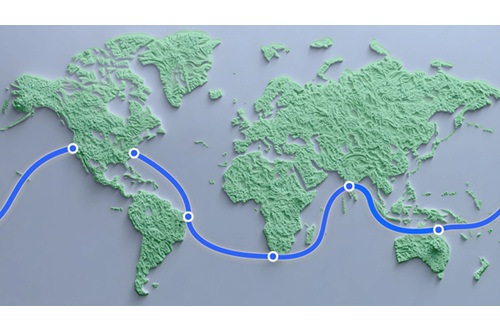
Traditional Role of CLS: Bridging Oceans
In their earlier form, CLS primarily served as termination points for submarine cables, converting optical signals into data for terrestrial networks. While this traditional model supported basic connectivity, it lacked scalability and failed to meet the growing demands of today’s interconnected world. The exponential growth of global data traffic, cloud computing, and streaming services has exposed the limitations of this legacy approach.
Modernization of CLS: Dynamic Hubs of Connectivity
Today's CLS are evolving into highly sophisticated hubs of connectivity. These modern facilities are being integrated with data centers, enabling them to provide scalability, lower latency, and direct access to multiple cloud providers and networks. They now function as critical nodes in the global data ecosystem, accommodating the needs of content delivery networks and supporting the increasing demand for reliability and speed.
Strategic Siting of CLS: Location Matters
The effectiveness of a CLS is closely tied to its location. Strategic considerations include proximity to major population centers, connectivity hubs, and robust backhaul networks. Geopolitical stability, regulatory support, and environmental resilience are also crucial factors. Locations prone to natural disasters require additional protective measures to ensure infrastructure stability, while access to multiple backhaul options enhances network resilience.
The Rise of Hybrid CLS Models
To meet growing demands, hybrid CLS models are emerging as versatile facilities that integrate submarine cable termination with large-scale data centers. These models offer colocation services, enabling efficient data processing and storage while reducing latency. By colocating with data centers, CLS can handle higher data volumes and provide improved service delivery to end-users, shaping the future of global connectivity.
Technological Advancements Shaping CLS
Technological innovations are driving CLS evolution. Advances in fiber optics have increased cable capacity, with modern cables supporting higher fiber pair counts and improved data transmission speeds. AI and machine learning are revolutionizing CLS management, enabling predictive maintenance, real-time routing optimization, and efficient resource allocation. These advancements ensure CLS remain at the forefront of global communications.
The Open CLS Concept: Flexibility and Innovation
The “Open CLS” model represents a paradigm shift in how these facilities operate. By allowing multiple operators to share infrastructure, Open CLS fosters competition, reduces costs, and accelerates innovation. This flexible approach enables seamless integration of new cables and enhances the overall efficiency of global connectivity networks, as demonstrated by projects like Google’s Dunant cable.
Challenges and Opportunities
Despite their evolution, CLS face challenges such as regulatory hurdles, environmental concerns, and power constraints. Addressing these issues requires early engagement with stakeholders, sustainable practices, and adherence to international best practices for cable protection. The integration of renewable energy sources and energy-efficient cooling systems is paving the way for environmentally responsible CLS designs.
Future Outlook: CLS at the Forefront of Connectivity
The transformation of CLS is reshaping the global connectivity landscape. As key enablers of international data traffic, they are becoming essential components of the digital ecosystem. With continued advancements in technology, strategic planning, and a focus on sustainability, CLS are poised to ensure seamless, resilient, and efficient global communications for years to come.
To read the complete article, check out Issue 139 of the Sub Tel Forum Magazine here